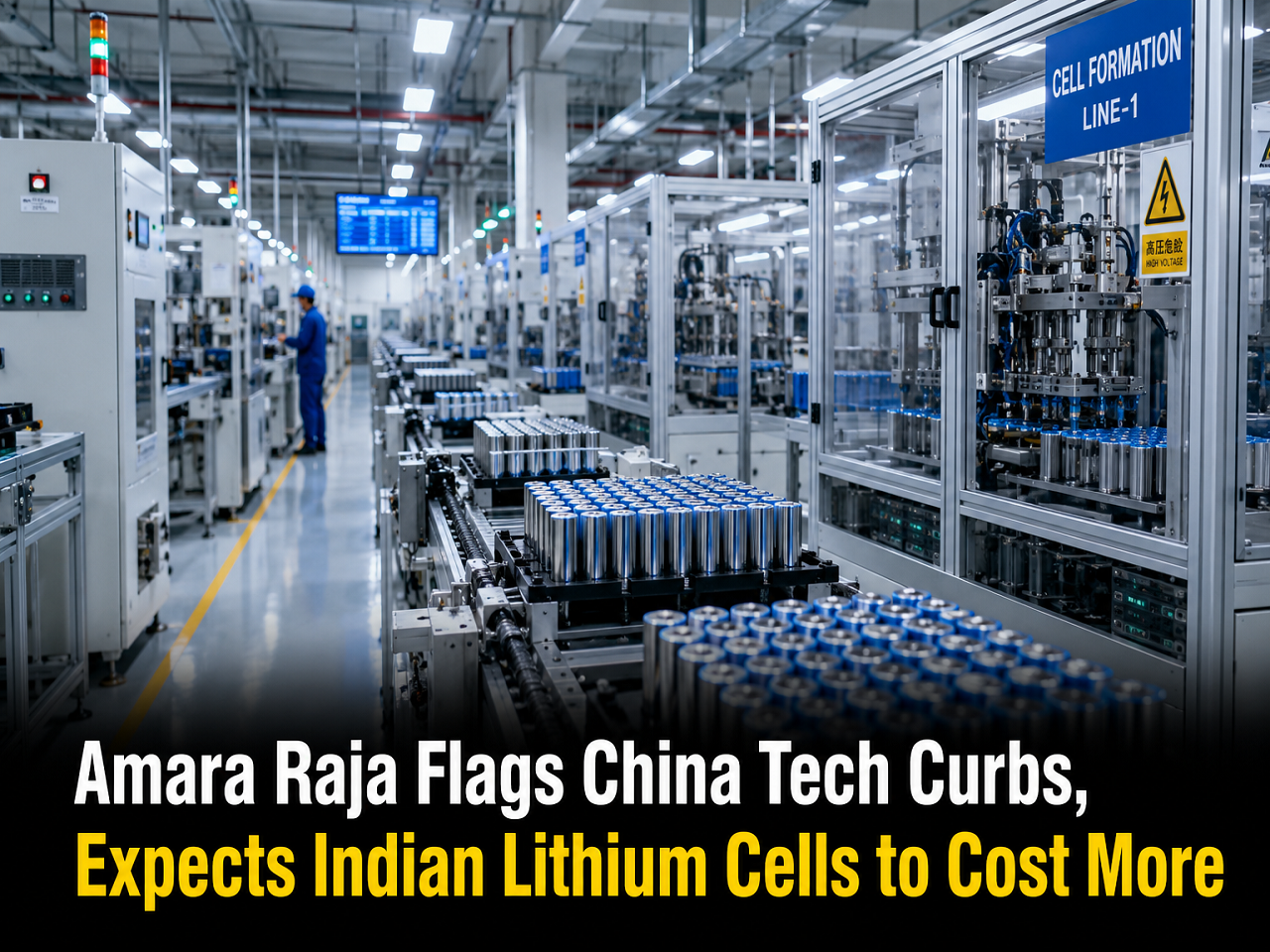
Amara Raja Flags China Tech Curbs, Expects Indian Lithium Cells to Cost More
India
June 17, 2026
Amara Raja Energy & Mobility (ARE&M) has flagged growing challenges in accessing Chinese battery technology, saying restrictions on technology transfers from China are affecting licensing arrangements across the industry and forcing Indian manufacturers to accelerate indigenous development efforts. The company, which had announced a technology licensing arrangement with Chinese battery maker Gotion, said future product development would increasingly be driven by its own engineering and research teams as Chinese technology cooperation becomes more difficult. "Sharing of technology and licensing arrangements are being increasingly discouraged by the Chinese government," Vikramadithya Gourineni, Executive Director, New Energy Business, said during the company's Q4 FY26 earnings call. He added that the issue was affecting multiple players pursuing technology partnerships with Chinese firms. Building Indian Cell Market The comments come at a time when India is seeking to build a domestic battery manufacturing ecosystem to support electric mobility and energy storage ambitions, while several companies continue to depend on Chinese technology, equipment and supply chains. Amara Raja said its battery development efforts are now largely being driven internally, supported by its upcoming R&D infrastructure and pilot manufacturing facilities. The company's E Positive Energy Labs research centre is in the final stages of commissioning, while its Customer Qualification Plant (CQP) is expected to begin supplying commercial cell samples to customers in the coming months. The company maintained that its first 2 GWh lithium-ion cell manufacturing facility remains on track for commissioning in June 2027. However, management acknowledged that executing such projects remains challenging, citing difficulties in securing sufficient Chinese engineering support for equipment commissioning due to visa and regulatory constraints. Domestic Cell Manufacturing Amara Raja also highlighted the economic challenges facing domestic cell manufacturing, stating that Indian-made cells would initially struggle to match Chinese pricing. Management estimated that locally manufactured cells could begin with a 15-20% cost disadvantage compared with imported Chinese products due to the absence of a mature domestic supply chain, limited local raw material availability and lower manufacturing scale. Despite the near-term cost gap, the company said it expects competitiveness to improve as production volumes rise, localization deepens and government support mechanisms evolve. Executives indicated that battery storage could eventually see domestic-content requirements similar to those introduced in the solar sector through ALMM regulations. The company expects cell manufacturing operations to generate EBITDA margins of around 10-11% once production scales to 8-10 GWh, supported by declining capital costs and operational efficiencies. Pivoting Towards BESS Alongside its EV battery ambitions, Amara Raja is increasingly pivoting toward battery energy storage systems (BESS), which it now sees as a larger near-term opportunity than previously anticipated. The company plans to establish a 5 GWh energy storage system integration facility in Telangana by the end of calendar year 2026, with scope to expand capacity to 10 GWh. Management said rapid growth in renewable energy deployment and utility-scale storage projects has accelerated demand expectations for BESS, prompting a strategic shift in its capacity planning. While the company remains committed to its long-term target of building 16 GWh of battery cell manufacturing capacity, executives indicated that a larger share of this capacity may now be allocated to stationary storage applications rather than electric vehicles, reflecting evolving market dynamics. The remarks provide one of the clearest indications yet from an Indian battery manufacturer on the challenges posed by China's tightening grip on battery technology exports and the cost hurdles facing India's efforts to localize cell production.