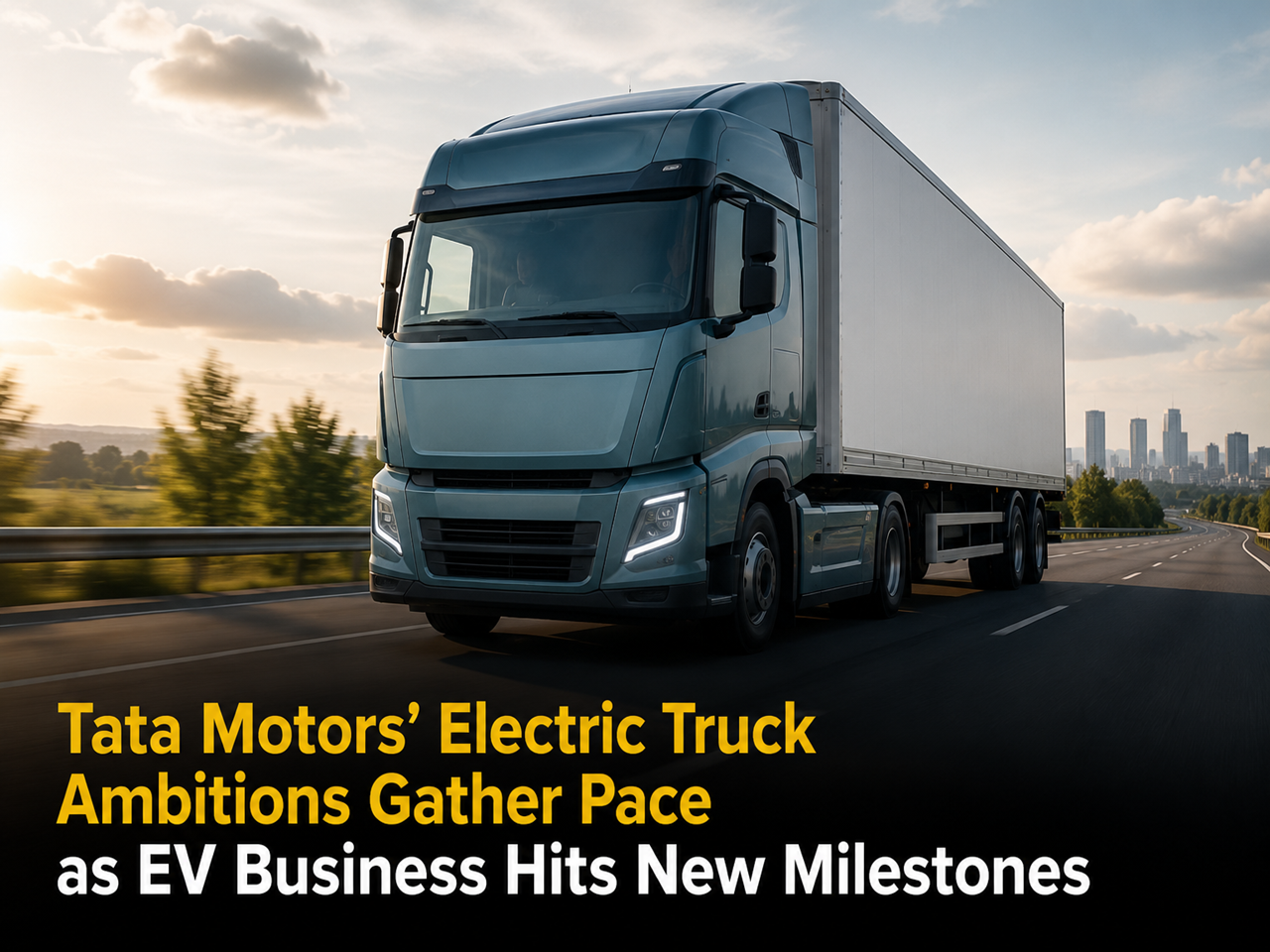
Tata Motors' Electric Truck Ambitions Gather Pace as EV Business Hits New Milestones
India
June 16, 2026
India's commercial vehicle market may still be overwhelmingly dominated by diesel-powered trucks, but Tata Motors is steadily laying the groundwork for a future where electric and hydrogen-powered freight transport becomes mainstream. The company, which reported record revenues of ₹77,000 crore and its highest-ever annual commercial vehicle sales of 4.28 lakh units in FY26, is increasingly seeing traction in its zero-emission mobility portfolio. While electric buses and light commercial vehicles have been the early success stories, Tata Motors now appears to be entering the next phase of its electrification journey: heavy-duty electric trucks. During its Q4 FY26 earnings call, the company revealed that it has begun deliveries of its 55-ton electric tractor-trailer trucks under an agreement with logistics operator BillionE Mobility. The development marks one of the most significant commercial deployments of heavy electric freight vehicles by an Indian truck manufacturer to date. Tata Motors said it is working closely with customers to deploy these vehicles across real-world duty cycles and freight operations. The announcement comes at a time when the company's broader electric vehicle business is showing strong momentum. Tata Motors reported its highest-ever EV retail sales in the fourth quarter despite the discontinuation of FAME incentives, indicating that commercial EV adoption is increasingly being driven by operational economics rather than subsidies alone. Electric Trucks: The Next Frontier While electric buses have dominated India's commercial EV narrative over the past few years, the trucking segment is now emerging as a key battleground. Rising diesel costs, corporate decarbonisation commitments, sustainability-linked procurement policies, and improving battery technology are creating a stronger business case for electric freight transport. For Tata Motors, the timing is significant. The company already commands a dominant position in India's medium and heavy commercial vehicle market. Any meaningful shift towards electrified trucking is likely to benefit established manufacturers with deep customer relationships, service networks, and fleet management capabilities. The 55-ton electric tractor-trailer deployment suggests Tata Motors is moving beyond pilot projects and demonstrating confidence in commercial-scale applications. Heavy trucks account for a disproportionate share of freight-related emissions, making them a critical segment for India's net-zero ambitions. The company has also indicated that expanding its battery-electric vehicle portfolio will remain a key priority in FY27. Management highlighted increasing battery-electric offerings as one of the growth drivers for the truck business going forward. Strong EV Momentum Beyond Trucks The momentum is not limited to heavy-duty vehicles. In the small commercial vehicle segment, Tata Motors said electric vehicle penetration rose from around 4 per cent during FY26 to nearly 7 per cent towards the end of the fiscal year. New launches such as the Intra EV have received encouraging market response, aided by improving operating economics and competitive pricing. Management noted that demand for the Intra EV has been strong enough to warrant a phased production ramp-up, underscoring growing acceptance of electric cargo vehicles among last-mile and urban logistics operators. Electric Buses Continue to Build Scale Tata Motors also remains one of India's largest electric bus operators through its smart mobility business. The company disclosed that more than 3,815 electric buses are currently deployed across the country, having cumulatively covered over 590 million kilometres while maintaining uptime levels exceeding 96 per cent. Additionally, the company has secured orders for around 250 electric buses and continues to participate selectively in government tenders, even as it remains cautious about aggressive bidding in the segment. Hydrogen Enters the Equation Alongside battery-electric mobility, Tata Motors is also exploring hydrogen-powered freight solutions. The company recently signed an MoU with V.O.C. Port in Tamil Nadu to supply and trial 40 hydrogen internal combustion engine (H2-ICE) trucks. The pilot reflects Tata Motors' view that India's future commercial vehicle ecosystem could eventually comprise a mix of battery-electric, hydrogen fuel-cell and hydrogen combustion technologies depending on use cases and operating conditions. The Road Ahead For now, electric trucks remain a small fraction of India's overall freight market. Charging infrastructure, vehicle costs, route planning and financing models continue to pose challenges. Yet Tata Motors' latest disclosures suggest that the company is beginning to see meaningful commercial interest beyond electric buses and last-mile delivery vehicles. Having already demonstrated strong EV adoption in buses and light commercial vehicles, Tata Motors is now positioning itself to capture the next wave of commercial transport electrification. If the early deployments of its heavy-duty electric trucks prove successful, the company could play a pivotal role in shaping India's transition towards cleaner freight mobility.